Timeless Water Therapy
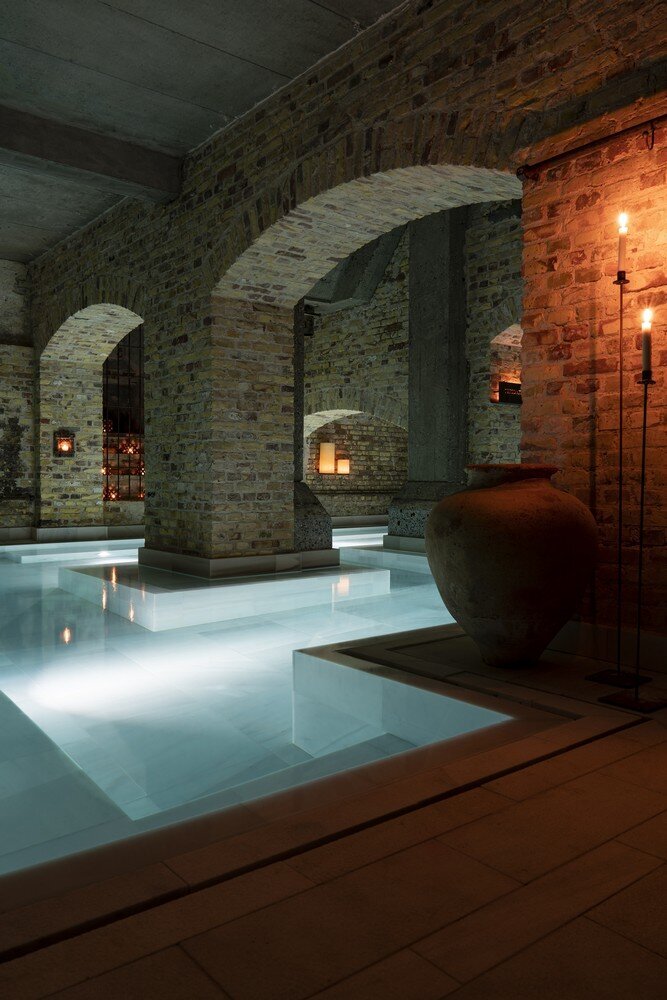
The Ancient Thermal Baths at Aire Copenhagen. Inspired by the tradition of baths from ancient Roman, Greek and Ottoman civilizations.
The medicinal and therapeutic benefits of using water for healing date back to 2000 BC, when the Ancient Egyptians practised bathing rituals in the hope of curing ailments. With Hippocrates and the holistic thinking of the Greek medical tradition, the idea of the ‘Water Cure’ became a universal method for healing and restoration — rituals that are still practised in many modern spa resorts to this day.
Water as Medicine
Hippocrates, known as the ‘Father of Medicine’, was the first to document the ‘Water Cure’ as a healing tradition in Greek medicine, prescribing the use of water to treat illnesses. He was also the first to theorise the therapeutic properties of various waters — whether rain-fed or bubbling from mineral springs — and the differing curative effects of their minerals, including iron, copper, silver, gold, or sulfur.
By the early 1800s, the use of water for therapy had evolved into thalassotherapy. Derived from the Greek word for ‘sea’, thalassotherapy encompasses a range of treatments using seawater and seaweed, each designed to tone, moisturise, and revitalise the body and skin, and in many cases, to improve circulation.
Thalassotherapy now comes in a wide variety of forms: mud baths, underwater showers, hydro-massage, aromatherapy, and wraps of seaweed, mud, or algae — all intended to restore the body to a state of serenity.

‘Flotarium’ Sea Salt Expereince at Aire Ancient Baths. A Water Experience that takes you on a timeless journey of serenity, healing and magic in restored historical buildings in cities such as Copenhagen, Sevilla, New York and Chicago.
Water as Therapy
Most modern applications of water therapy are based on the practice of hydrotherapy, which originated in 19th-century Europe. Today, hydrotherapy is often used alongside traditional hands-on physical therapy, employing techniques and tools such as underwater massage, water jets, mineral baths, cold plunges, and hot tubs.
Different forms of hydrotherapy produce different effects, helping the body to relax, tone muscles, cleanse the skin, reduce the appearance of cellulite, boost the immune system, or improve sleep quality. Water temperature also impacts the body in distinct ways: hot water relaxes muscles and relieves joint tension, while cold water stimulates circulation, tones the skin, and provides a reinvigorating effect.
Water allows the body to feel weightless and buoyant while offering natural resistance to movement, making it an ideal medium for rehabilitation and fitness training. Water exercises can tone muscles, increase range of motion, ease pain, improve joint flexibility, relieve muscle spasms, reduce inflammation, facilitate low-impact aerobic exercise for weight management, and speed recovery from injuries — enabling exercise to begin sooner than on land.

SEMINE was invited to try the high hydration ‘Holistic Ritual’ at Aire Ancient Baths in Copenhagen. An experience designed to holistically pamper and hydrate the skin that includes a full-body exfoliation and a delicate massage while your hair is nourished by a honey hydrating mask that leaves you in a state of pure bliss! You can book your own healing experience here.
“Keep moving in the Stream of Life. Shed your past like a tear drop. Wash your heart 7 times and let its River flow.
”
Water as Change
The idea of water as a symbol of life’s flow appears across many cultural and spiritual traditions. In the Old Testament, people soaked in mineral waters for physical healing. The Ancient Greeks used water as a healing agent, and Native Americans visited ‘Big Medicine’ mineral springs and participated in sweat lodges to purify body and mind. In Sanskrit, “Narayan” is a name of God in his infinite, all-pervading form, often translated as “the one who moves in the infinite waters and is also the water itself.” The Greek philosopher Heraclitus also reflected on water as a symbol of change, famously saying that you cannot step into the same river twice — illustrating his belief that everything is constantly in flux.
“No man ever steps in the same river twice, for it’s not the same river and he’s not the same man.”
Water serves as a metaphor for the ebb and flow of our own lives and as a powerful ally for cleansing and restoration. We can all relate to the daily shower as a way to ‘restart’ — to wash away the old stories of the day and offer ourselves a fresh beginning.
Just like the water in a river, our lives are always changing. Even if the water — or our life — appears the same, it is never truly identical. Not only as a medium but also as a metaphor, water is our healing element in life rituals, cleansing body, mind, and soul of the past and allowing us to step into a renewed, refreshed version of ourselves.
Water as Carrier
From a physical perspective, water is an element of constant change: when cold, it crystallises and freezes; when hot, it steams; when touched, it ripples. Water makes up between 65% and 78% of the human body, depending on age, comprising over 70% of our brain, heart, skin, muscles, kidneys, lungs, and liver. Even 31% of our dry bones are water. The more water we lose, the more our bodies deteriorate — and when we are only 50% water, we cannot survive. We are water in human form.
Water’s structure reacts to stimuli. Its molecules are organised in clusters that function like “memory cells.” Within each memory cell, there are roughly 440,000 information panels responsible for interacting with the environment, making water nature’s single most malleable computer, according to Rustom Roy, materials scientist and professor emeritus at Pennsylvania State University. Whatever water experiences — what it hears, sees, or feels — becomes a catalyst for change, as it copies, memorises, and transports information.
Japanese researcher Masaru Emoto demonstrated this in his New York Times bestselling book The Hidden Messages in Water, showing that water exposed to loving, benevolent, and compassionate human intention forms aesthetically pleasing molecular structures, while water exposed to fearful or discordant human intentions produces disconnected, disfigured, and “unpleasant” molecular formations.
Be Water
The beauty of water therapy is endless, and perhaps its most profound effect is its rippling power to heal. When we open ourselves to water’s therapeutic properties — both as a healing aid and as a natural technology — we can harness one of nature’s strongest elements as a catalyst for physical and emotional transformation. We send a message to our body that we respect it, listen to it, and honour it as a vessel of sacred nature, treating it with love and care.
When we recognise the sacredness of our bodies and truly treat them as temples, we also cultivate the expectation that others — and the world itself — will do the same. This is the true power of ritual. The body remembers the imprints we plant, and when we fill ourselves with love, reverence, and the healing touch of another human being, we send a powerful signal to our nervous system: to surround ourselves with care, respect, bliss, and love.

The threshold to the urban Water Oasis Aire Ancient Baths.
“Your body is your sacred vessel on the journey called Life. It is the house of your soul. A holy temple. Treat it with deep reverence. ”

WATER THERAPY TERMS
Hydrotherapy: techniques of therapeutic bathing and use of water
Balneotherapy: therapeutic bathing in medicinal and thermal springs
Thalassotherapy: the therapeutic use of ocean bathing and marine products.